XRP OI Climbs 1.4% While 74.2% of Accounts Stay Long and Exposed
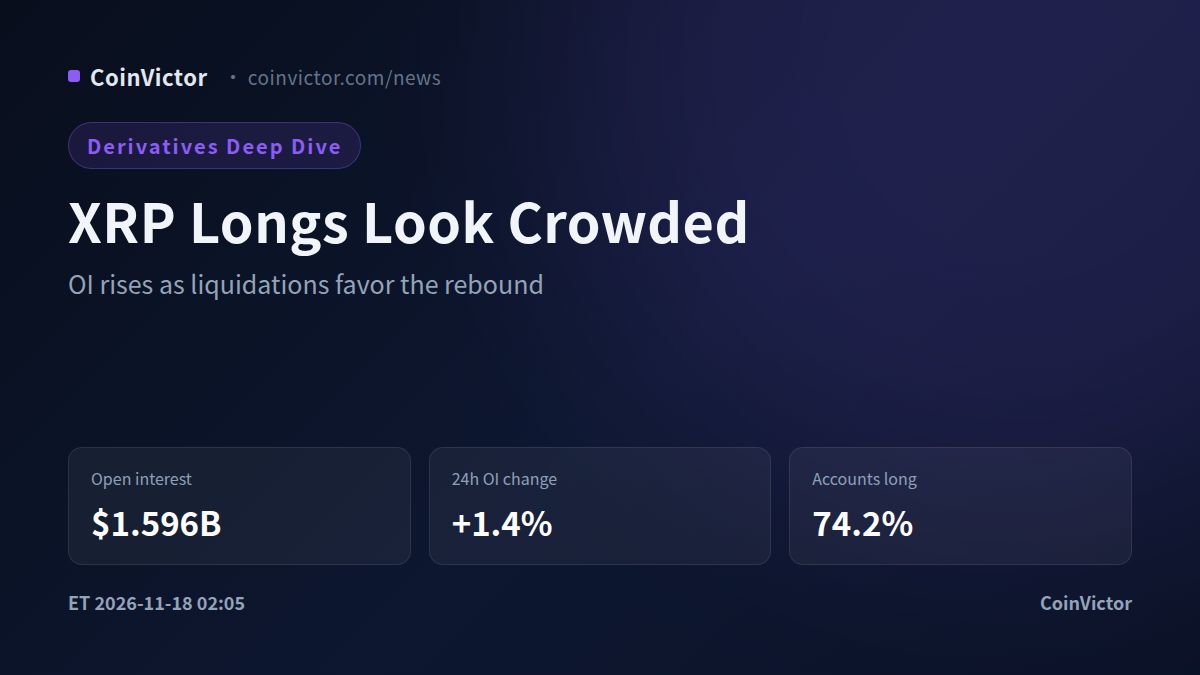
At $0.9875, XRP is attempting to stabilize while derivatives positioning grows more aggressive: open interest stands at $1.596B, up 1.4% over 24 hours, and 74.2% of tracked accounts are long. The key tension is that price has recovered while the broader structure remains defensive. One-hour RSI is 65.0, but four-hour RSI is 52.7 and daily RSI is only 31.3. That combination describes a short-term rebound inside a market that has not yet repaired its medium-term trend.
Recent coverage has centered on institutional XRP exposure, persistent risk-off sentiment across major digital assets, Ripple’s financial-infrastructure ambitions and a reported reduction in the value of a Ripple-backed vehicle’s XRP holdings.
OI is rising, but the increase is concentrated
The open-interest expansion is not evenly distributed. Binance holds $329.3M, or 20.6% of the tracked total, with OI up 1.5% over 24 hours. Bybit holds $233.9M, or 14.7%, after a 2.1% increase, while Bitget holds $173.8M, or 10.9%, after rising 3.1%. OKX is smaller at $98.0M, or 6.1%, yet its OI has increased 3.4%. These venues collectively show fresh risk entering the long-heavy side of the market.
Gate is the important counterweight. It carries $220.8M, or 13.8% of the total, but its OI has fallen 1.3% over 24 hours and 1.5% over four hours. The broader exchange picture therefore looks less like a unified accumulation wave and more like rotation: leverage is being added on several major venues while another large venue is shedding exposure. That matters because a rally built on fragmented participation can lose momentum quickly if the leading venues stop adding contracts.
Volume is $2.189B, down 1.5% over 24 hours. Price is therefore rising without a corresponding expansion in turnover. The immediate interpretation is constructive but fragile: buyers are willing to defend the market, yet the move does not have the volume confirmation normally associated with a durable trend reversal.
Long bias meets uneven funding and a negative basis
The account split is decisively bullish. Binance shows 74.0% long, OKX 68.1%, Bybit 79.7%, Bitget 85.4%, Gate 65.6% and Kraken 72.5%. The aggregate account reading is 74.2% long, while taker flow is also tilted toward buyers at 73.2%. Taker positioning is especially extreme on Bitget, where longs represent 93.9% of taker accounts, compared with 85.6% on Gate. This is not merely passive account positioning; aggressive participants are also leaning into the rebound.
Funding does not fully validate that enthusiasm. The average eight-hour funding reading is positive but rounds to 0.0%, and individual venues are mixed. Bybit is at -0.0%, Binance at -0.0%, Bitget at -0.0% and OKX at 0.0%, while Gate is at 0.0% and HTX at 0.0%. The small differences matter directionally: leverage is not yet paying a large premium to hold longs, even though the account distribution is crowded. That reduces the cost of maintaining bullish exposure, but it also suggests the market has not reached a decisive positive carry regime.
The basis is -0.1%, using the reported -0.050659% reading. This is a particularly important contradiction. Spot is stronger than the derivatives curve, but futures are still priced at a discount rather than a premium. In a medium-term framework, negative basis plus rising OI says the market is adding contracts into uncertainty, not confirming a clean bullish repricing. Longs are vulnerable because they are numerous, while the weak basis leaves room for another spot-led squeeze lower.
Liquidations define the critical price map
Liquidation data shows that the market has already punished both sides, but the latest pressure has favored shorts. Over 24 hours, total liquidations reached $4.563M: $2.269M from shorts and $2.269M from longs. Over 12 hours, however, shorts accounted for $1.509M against $158.0K of longs. Over four hours, short liquidations were $61.6K versus $8.1K for longs. This is consistent with a rebound that is forcing bearish positions out, while the crowded long side has not yet suffered a fresh broad flush.
The largest recorded long liquidation was $390.1K at $0.9385 on Binance. Other long liquidation levels were $0.9539 and $0.9479, while the largest short liquidation was $230.6K at $0.9869 and another was $102.3K at $0.9812. These levels create a practical map. Around $0.9869 to $0.9812, the market has already shown that short positions can be squeezed. Below $0.9539 to $0.9479, long liquidation risk becomes more meaningful, with $0.9385 the clearest downside stress marker in the available data.
The positioning makes longs the more structurally fragile side, even though short liquidations currently dominate. A push above the current $0.9875 area could extend the short squeeze because the taker and account ratios leave relatively few bears in the book. But if price loses the $0.9539-$0.9479 band, the same crowded exposure can turn into forced selling, especially with OI still above $1.596B. The negative basis would then confirm defensive repricing rather than healthy dip-buying.
Verdict: XRP’s medium-term structure is a fragile rebound, not a confirmed trend reversal. The pivotal upside zone is $0.9869-$0.9875, while the key downside risk band is $0.9539-$0.9479, with $0.9385 as the deeper liquidation marker. The view would be invalidated if XRP holds above $0.9875 while OI continues rising from $1.596B without a renewed increase in long liquidations; conversely, a break below $0.9479 accompanied by OI expansion would confirm that crowded longs, not shorts, are the vulnerable side. Data as of 15:05 Beijing time on Nov 18, covering Binance, OKX, Bybit and other major venues.