Zcash Open Interest Falls 1.1% as $2.2B Structure Tilts Defensive
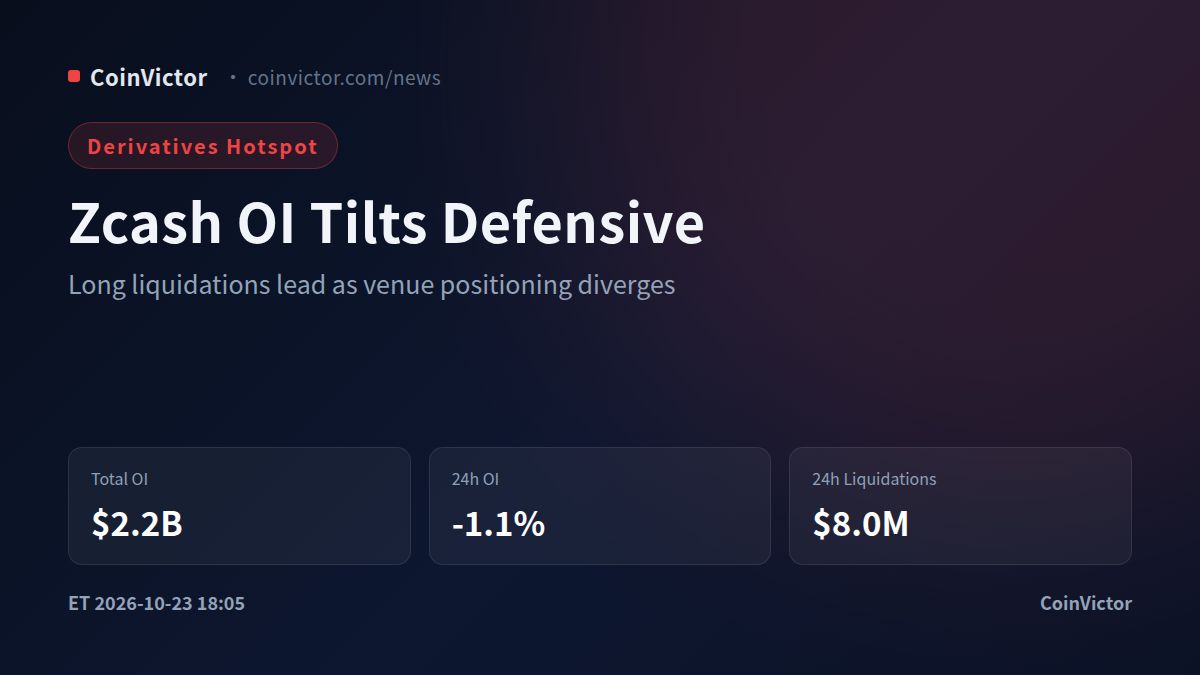
At $1,229.25, Zcash is sitting inside a defensive derivatives structure: aggregate open interest is about $2.2B after falling 1.1% over 24 hours, while the coin is down 0.9%. The important signal is not the headline decline alone, but where exposure is leaving, where it is still building, and how that positioning is interacting with liquidation pressure.
Recent market coverage has focused on ZEC's decline, fund-flow pressure, volatility, and renewed interest in the privacy-coin trade.
OI concentration is splitting by venue
Binance remains the largest listed OI pool at $529.0M, or 23.5% of the total, but its exposure fell 3.4% over 24 hours and 3.2% over four hours. Gate holds the next meaningful block at $379.1M, representing 16.9%, yet its daily OI increased 1.2% even as its four-hour reading declined 2.6%. That combination suggests some recent rebuilding, but not a clean expansion of risk across the whole market.
Bybit carries $160.5M, or 7.1%, and its OI dropped 3.2% over 24 hours and 4.3% over four hours. OKX is smaller at $125.1M and 5.6%, but its exposure contracted 6.5% daily and 3.1% over four hours. Bitget is the outlier: its $119.5M position base, equal to 5.3% of aggregate OI, rose 3.5% daily while still falling 2.5% over four hours. The broad pattern is therefore contraction in the most visible venues, offset by selective accumulation rather than broad conviction.
Funding shows a crowded but uneven trade
The funding rate map is mostly positive, but the dispersion is unusually important for interpreting OI. CoinEx shows 0.2%, far above the 0.0% readings on Binance, Bybit, Gate, and several other large venues. Bitmex is also 0.0%, while Bitget and Bitfinex are both -0.0%. Positive funding normally indicates longs paying shorts, but the near-zero readings at the largest OI venues imply that long carry is not yet aggressive enough to confirm a strong bullish build.
This uneven funding profile matches the OI data. If the market were adding synchronized upside risk, the largest venues would likely show both rising OI and more consistently positive carry. Instead, Binance, Bybit, and OKX are losing exposure, while the strongest positive funding is concentrated away from the largest OI block. That is more consistent with fragmented positioning than a durable trend.
Liquidations favor the downside flush
The liquidation structure adds a bearish short-term tilt. Over 24 hours, total liquidations reached $8.0M, with $4.4M in longs versus $3.6M in shorts. The imbalance was sharper over four hours: $1.5M of longs were liquidated against $1.0M of shorts. In the latest hour, long liquidations were $41.5K while shorts were only $1.1K.
The largest recorded forced exits clustered on Binance near $1,200.26, $1,201.96, and $1,208.61, with another sizable long liquidation at $1,183.74. Those levels create a clear downside map beneath the current price. Yet the positioning signal is not one-sided: the long/short ratio by accounts is 52.0% long, while active takers are only 46.7% long. Accounts are leaning bullish, but traders executing immediately are net short. That divergence can support a rebound if sellers fail to extend the move, but it also means passive long accounts remain vulnerable to another liquidation wave.
Verdict
The exclusive read is defensive: the market is most exposed to a test of $1,200.26, with $1,183.74 the deeper liquidation trigger, while total OI near $2.2B has not yet shown broad-based rebuilding. The view would be invalidated if ZEC sustains a move above $1,229.25 while total OI expands from $2.2B instead of continuing to contract. Data as of 06:05 Beijing time on Oct 24, covering Binance, OKX, Bybit and other major venues.