All Top-20 Liquidations Are Longs: $30.9M Wiped in 60s
Every single one of the top-20 liquidation orders is a long
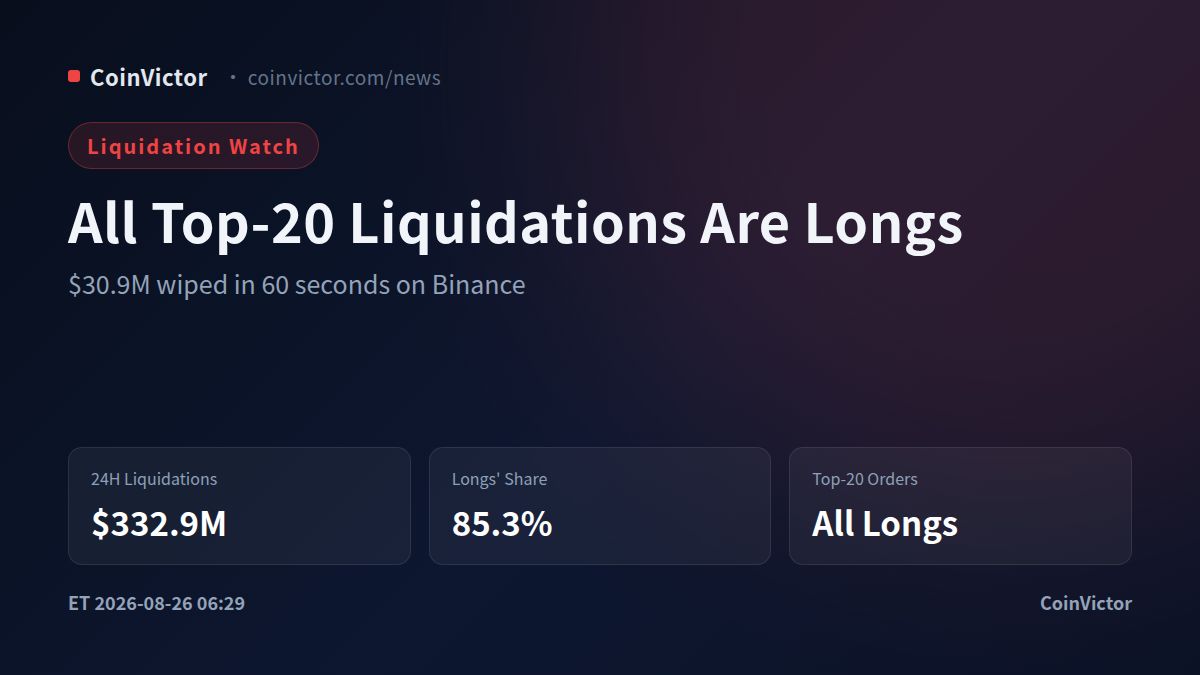
The liquidation board tells a one-sided story today. The 20 largest single liquidation orders across the market are all longs, with zero short positions in the list. They add up to $42.4M in forced selling, and 10 of them landed inside a 60-second window on Binance, $30.9M combined. The biggest order was a $11.8M BTC long wiped at $77,332, followed by a $6.6M ETH long at $2,408. When the list of top orders carries no shorts at all, it usually means one sharp downward move took out a concentrated group of leveraged buyers at roughly the same price.
Longs paid 85.3% of $332.9M in 24-hour liquidations
The broader picture matches that one-sidedness. In the last 24 hours, $332.9M in liquidations were recorded across major venues, and 85.3% of that total, or $283.9M, was long positions. Shorts contributed only $49M. The shorter windows tell the same story in miniature: the 12-hour window shows $50.6M wiped with 57.9% longs, and the 1-hour window shows $7.9M with 87% longs. So the pressure has been building on buyers throughout the day, not just in one isolated burst.
Why the all-long top list matters for traders
An all-long top list is a useful tell, because it shows where leverage was concentrated when price turned. BTC, ETH and XRP dominate the largest orders, which means crowded long leverage sat in the highest-liquidity names, not in speculative corners. When a pullback happens after a strong rally, longs that entered late near the top are the first to get flushed. The flip side is that once those positions are gone, the immediate selling pressure from forced liquidations drops, which is one reason flushouts like this often mark short-term bottoms rather than the start of a prolonged decline. It does not mean the move is over, but it means a chunk of weak leverage has already been removed from the market.
What to watch after the flush
For traders, the key question is whether fresh longs come back in or whether open interest keeps shrinking. When a long flush happens and open interest rebuilds within hours, the move tends to continue; when open interest keeps falling, the market is still shedding leverage. Funding rates are another gauge. If funding turns clearly negative after a long flush, shorts start paying longs, and that usually sets up a bounce. If funding stays flat and open interest drifts lower, the market is likely grinding sideways while it digests the loss. Watch BTC around the $77.3K liquidation cluster and XRP near $1.40, the two levels where the largest orders were filled.
Data as of 18:29 Beijing time on August 26, covering Binance, OKX, Bybit, Hyperliquid, Gate, Bitget and other major exchanges.