Aster Derivatives: 33.1% OI Share Meets a 0.1% Funding Skew
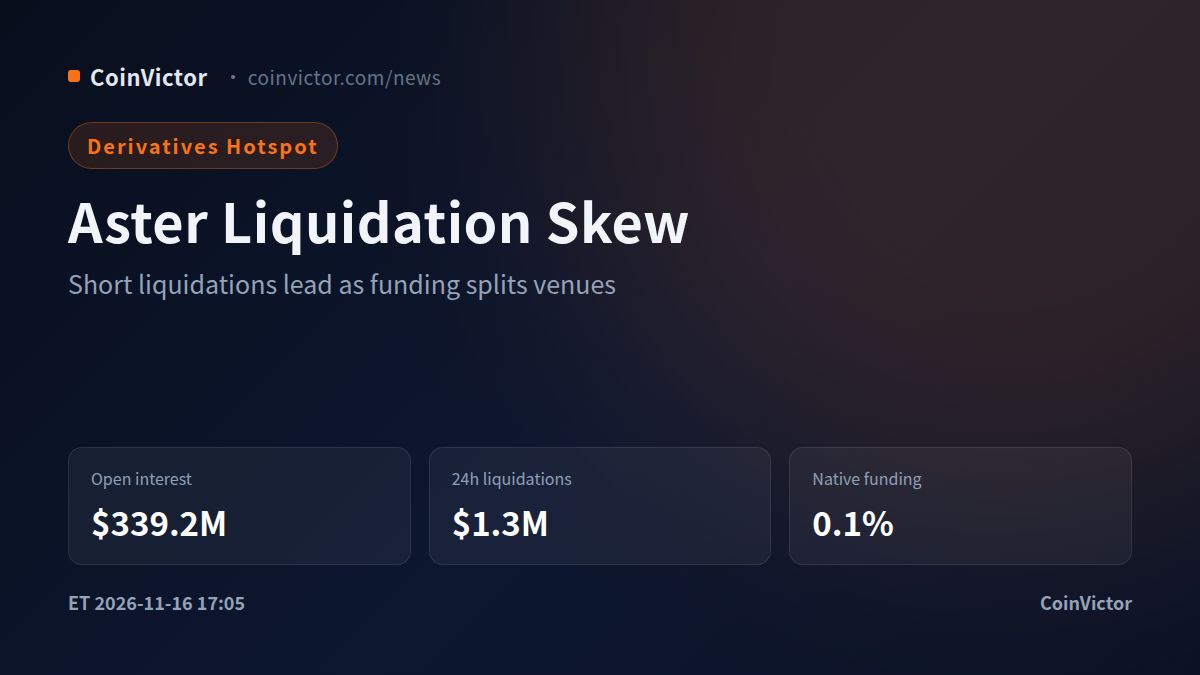
Aster is showing a sharp derivatives split: total open interest stands at $339.2M after rising 10.0% in 24 hours, while the latest liquidation window favors shorts. One-hour liquidations reached $38.3K, with $27.7K in shorts versus $10.5K in longs. Recent coverage has focused on abrupt ASTER price swings and an executive review of the liquidation activity, but the market data itself points to a more nuanced positioning story.
OI is concentrated, but expansion is uneven
The open interest leaderboard puts Aster's own venue first at $112.3M, or 33.1% of tracked OI, up 25.4% in 24 hours. Binance follows with $79.8M and a 23.5% share, up 9.7%. Bybit holds $36.2M, or 10.7%, with a modest 0.2% increase, while Gate contributes $32.3M, or 9.5%, after adding 5.5%.
This concentration matters for the liquidation skew. The largest visible short events include $117.2K at $0.5120 on Binance and $115.2K at $0.5353 on Aster's venue. Those prints suggest that short exposure has been vulnerable during rebounds, especially while the overall OI base continues to grow. Yet Binance's four-hour OI change is only 0.5%, Bybit is up 0.8%, and Gate is down 0.4%, so the aggregate expansion is not a uniform buildup across the main venues.
Funding shows a clear venue split
The funding rate is the strongest expression of the imbalance. Aster's displayed rate is 0.1%, versus 0.0% on Binance, Bybit's -0.0%, and OKX's 0.0%. Backpack is also at 0.0%, while Kraken, Hyperliquid, and Lighter are negative at displayed one-decimal precision. This gap indicates that the most expensive long carry is concentrated on Aster's own venue rather than shared evenly across the market.
That creates two competing readings. The short-led liquidations in the one-hour, four-hour, and 12-hour windows point to forced short covering and a potential squeeze. However, paying longs on the Aster venue are carrying a much heavier rate, and a crowded long book could become fragile if the rebound fails. The 24-hour liquidation total is $1.3M, with longs at $688.4K and shorts at $631.5K, so the broader session still has slightly more long-side damage than short-side damage.
Accounts and active flow disagree
The aggregate long/short ratio is nearly aligned: 59.3% of accounts are long and 59.3% of taker flow is classified as long. Venue detail is less comfortable. Binance accounts are almost flat at 50.0% long, but takers are 44.3% long, meaning active flow leans short. On OKX, accounts are 65.0% long while takers are only 49.8% long. Bybit accounts are 69.4% long, and Gate shows the reverse extreme: 54.3% long accounts against 83.7% long taker flow.
The disagreement reduces the reliability of the headline bullish signal. Passive account positioning is long-heavy on several venues, but active flow is either short-biased or aggressively long depending on the exchange. Bitget is an outlier with 100.0% long taker flow, while its accounts are 60.0% long. This is consistent with a market where liquidations, rather than a single unified directional consensus, are driving the most visible moves.
Verdict: The near-term liquidation skew remains mildly squeeze-positive for shorts, but the signal is not a clean bullish trend call. Watch $0.5684 against the $339.2M OI base, with $0.5665 as a nearby liquidation reference and $0.5353 and $0.5120 as the key downside liquidation levels. The squeeze view is invalidated if price breaks below $0.5353 while OI rises above $339.2M, because that would signal fresh leverage reinforcing downside rather than shorts being forced out. Data as of 06:05 Beijing time on Nov 17, covering Binance, OKX, Bybit and other major venues.