Aster OI Falls 14.4% to $343.0M as Funding Splits Across Venues
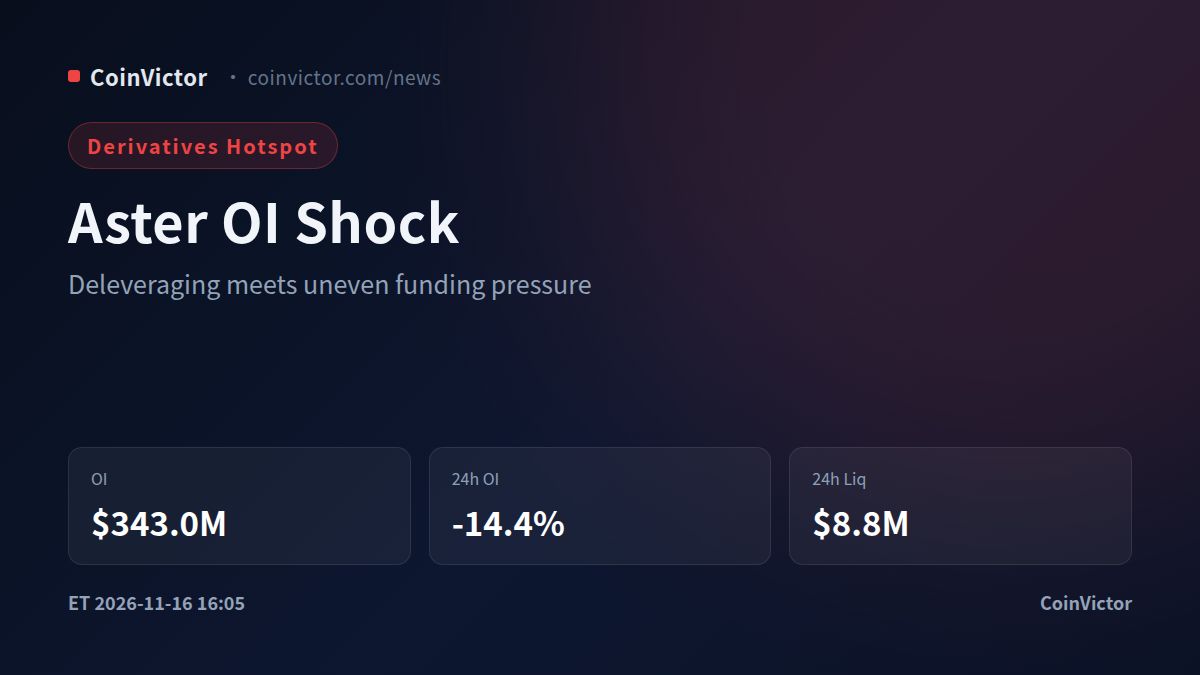
Aster is trading at $0.5694 with aggregate open interest near $343.0M, down 14.4% over 24 hours despite a 0.5% increase in the latest hour. That combination points to a market that has already shed leverage, but is attempting to stabilize before positioning fully resets. Recent coverage says Aster’s CEO is examining whether targeted liquidations helped drive the token’s abrupt swings.
OI contraction is broad, but not uniform
The largest reported exposure sits on Aster’s own venue at $112.1M, representing 32.7% of tracked OI after a 19.0% daily decline. Binance follows with $79.8M, or 23.3% of the total, and its OI is down 12.3%. Bybit holds $36.2M, equal to 10.6%, after a 15.5% reduction. Gate contributes $32.4M, or 9.4%, with a 13.7% decline.
The short-term picture is less uniformly defensive. Binance OI is up 0.1% over the latest four hours, while Bybit is up 0.5%, Bitget is up 1.3%, and Aster’s own venue is up 0.9%. In contrast, OKX is down 2.1% over the same window and Gate is down 0.1%. This suggests selective re-entry rather than a broad return of leverage: traders are rebuilding risk on some liquid venues while total exposure remains materially below the prior day’s level.
Funding shows a crowded venue, not a balanced market
The current funding rate is exceptionally uneven. Aster’s venue shows 0.1% on the displayed percentage scale, compared with 0.0% on Binance, Bybit, Bitget, Gate, OKX, and several other major venues after one-decimal rounding. The ticker’s average eight-hour funding reading is 0.0% at that precision, so the headline average masks the concentration of positive carry on Aster’s venue.
That split matters because paying longs can remain crowded on one venue even while the broader derivatives market is deleveraging. The venue-level funding premium is therefore a warning against interpreting the latest hourly OI rise as a clean bullish signal. It may instead reflect traders paying to maintain directional exposure after the sharp price move.
Long liquidations lead, while flow disagrees
Across the latest 24-hour window, liquidations reached $8.7M, with $6.2M from longs and $2.6M from shorts. The imbalance was nearly even over four hours, at $6.5K in long liquidations versus $6.3K in shorts, but the twelve-hour window flipped toward shorts with $184.7K versus $238.3K. The sequence suggests an earlier squeeze in both directions followed by a much larger daily hit to long positions.
The largest recorded events reinforce the wide price map. A short liquidation worth $443.0K occurred at $0.7086, while a $326.7K long liquidation printed at $0.4827. Other large long liquidations appeared at $0.4854, $0.5565, and $0.6442. These levels frame the market’s recent leverage stress more clearly than the spot price alone.
Positioning also contains a meaningful signal conflict. The account-based long/short ratio is 59.4% long overall, while active takers are 58.3% long. Yet Binance accounts are almost balanced at 49.8% long, compared with 65.3% long among its takers. OKX accounts are 65.5% long, but takers are 49.8% long; Bitget accounts are 60.0% long while takers are only 34.3% long. Gate is the extreme opposite, with 54.7% long accounts but 83.7% long takers. This divergence says passive positioning remains optimistic, while aggressive flow is fragmented and, on some venues, decisively defensive.
Verdict: Aster’s dominant signal is deleveraging, not a confirmed OI-led recovery. The key downside stress zone is $0.4827-$0.4854, while $0.7086 is the upper liquidation reference. The bearish, fragile-rebound view is invalidated if price reclaims $0.7086 while aggregate OI rises above $343.0M; that would show fresh leverage returning with price confirmation rather than a temporary funding-driven bounce. Data as of 05:05 Beijing time on Nov 17, covering Binance, OKX, Bybit and other major venues.