Solana at $99.95: $4.69B OI Exposes a Fragile Long Setup
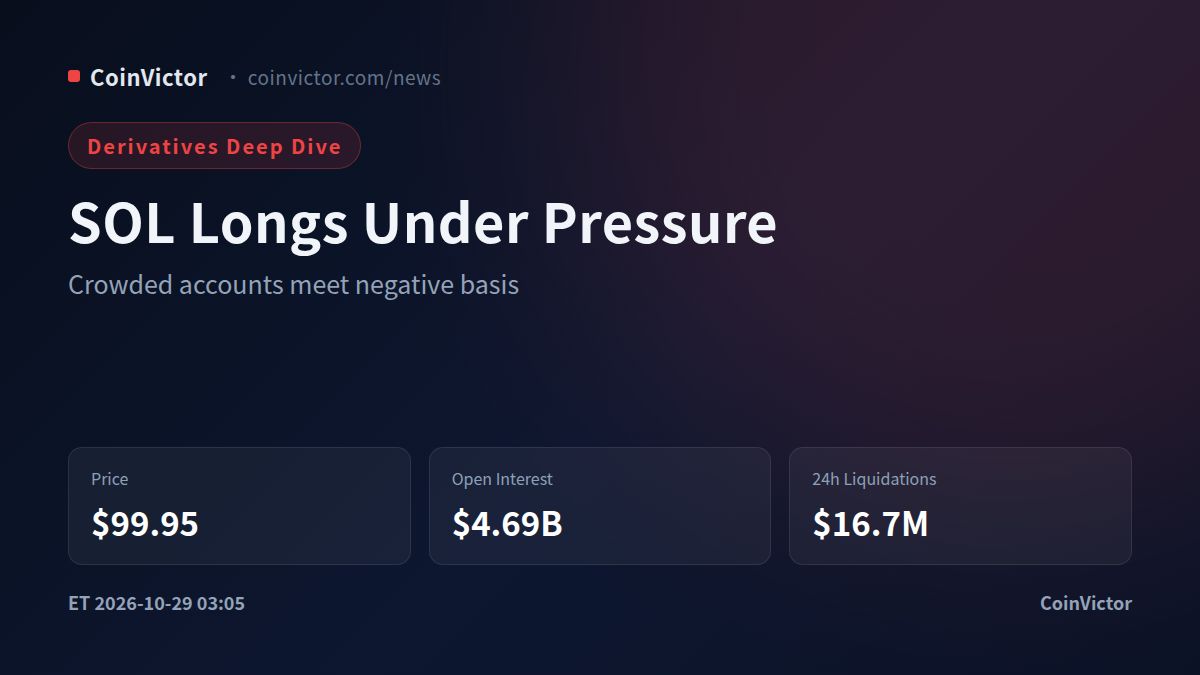
Solana is trading at $99.95 after a 1.9% decline, but the more important signal is the positioning beneath that move: $4.69B in open interest, 77.9% of tracked accounts long, and a deeply negative annualized basis of -21.9%. Taken together, these figures describe a market where longs remain numerous even as futures pricing shows defensive demand for downside exposure. Recent market coverage has focused on SOL weakness and a contested technical outlook, but derivatives positioning offers a more specific explanation of why the current structure remains vulnerable.
OI is falling, but not cleansing the trade
Total OI is down 1.5% over the past day, while spot and derivatives volume rose 47.8% to $5.60B. That combination matters. A price decline accompanied by shrinking OI normally suggests leverage is being removed, which can eventually improve market quality. Here, however, the reduction is modest relative to the $4.69B still outstanding. The market has lost some positions, but not enough to show that the long crowd has been fully reset.
The venue split adds an important nuance. Binance carries $910.4M of OI, or 19.4% of the aggregate, after a 2.4% daily decline. OKX holds $325.8M and fell 3.0%, while Gate has $860.3M and declined 0.9%. By contrast, Bybit increased OI 1.0% to $601.1M, with its shorter-term OI up 1.3%. This is not a uniform deleveraging event. Some venues are reducing exposure while others are rebuilding it into weakness, leaving the market vulnerable to a sharper move if those new positions are wrong.
The one-hour change is also slightly positive at 0.2%, a small sign that leverage is beginning to return even though the twenty-four-hour trend remains negative. Unless price can stabilize first, renewed OI is more likely to represent trapped positioning than durable accumulation.
Account longs are crowded, while takers lean short
The account data shows a pronounced imbalance. Binance has 76.6% of accounts long, OKX 76.5%, and Bybit 77.3%. Bitget is the most extreme at 86.9%, while Gate is still 72.1% long. Across the tracked sample, the long share is 77.9%. This is a crowding signal, not proof that price must fall, but it means a downside move can force many participants to exit in the same direction.
More aggressive flow is less one-sided than the account count. Binance takers are nearly balanced at 49.5% long and 50.5% short. OKX takers are 42.9% long versus 57.1% short, and Gate takers are only 20.3% long against 79.7% short. The contrast says passive or existing accounts remain heavily long while new market-taking orders are already positioned more defensively. That split can create two different outcomes: continued weakness if short takers press into a crowded long base, or a squeeze higher if the short flow is forced to cover before the long accounts capitulate.
The funding rate reinforces that the market is not uniformly paying to be long. The average is positive at 0.0024%, but Binance is -0.0002% and Bybit is -0.0022%, while OKX is 0.0026%, Bitget 0.0058%, and Aster 0.0072%. Funding is therefore fragmented rather than aggressively bullish. The positive pockets show that longs still pay for exposure on several venues, while negative rates on large venues show that short demand is already meaningful.
Liquidations and basis define the price map
Liquidations have already favored longs. The latest hour recorded $116,664 of long liquidations and no reported short liquidations. Across the wider day, long liquidations reached $9.1M versus $7.7M for shorts, for a total of $16.7M. The imbalance is not extreme enough to prove a capitulation, but it confirms that the decline is extracting pain from the dominant account side.
At the same time, the liquidation map shows that shorts are not absent. Large short events were recorded near $103.30, $103.98, and $104.10, with another at $106.12. A move back through that cluster could trigger short covering and give the market a quick test of higher resistance. On the downside, a long liquidation near $100.16 is particularly relevant because it sits close to the current $99.95 price. Failure to hold that area would leave crowded longs exposed to another liquidation wave.
The futures basis is -6.0% annualized on the immediate reading and -21.9% when annualized across the reported basis measure. Such a discount says traders are willing to hold futures below spot, a defensive condition that can precede stabilization but also reflects poor confidence in upside continuation. With daily RSI at 35.4, four-hour RSI at 43.1, and hourly RSI at 39.5, momentum is weak without yet showing an extreme washout.
Verdict: The medium-term structure is bearish-to-fragile, with longs more vulnerable than shorts because 77.9% of accounts are long, long liquidations already lead at $9.1M, and $4.69B of OI remains after only a 1.5% daily reduction. The key downside checkpoint is $100.16; a sustained break below it would favor another long-liquidation leg. The first recovery test is the $103.30-$104.10 short-liquidation cluster. This view is invalidated if SOL reclaims $104.10 while OI expands above $4.69B and taker flow stops leaning short; without that combination, rallies into the cluster remain vulnerable to rejection. Data as of 15:05 Beijing time on Oct 29, covering Binance, OKX, Bybit and other major venues.