Sui Basis Hits -15.9% Annualized as $555.1M OI Contracts
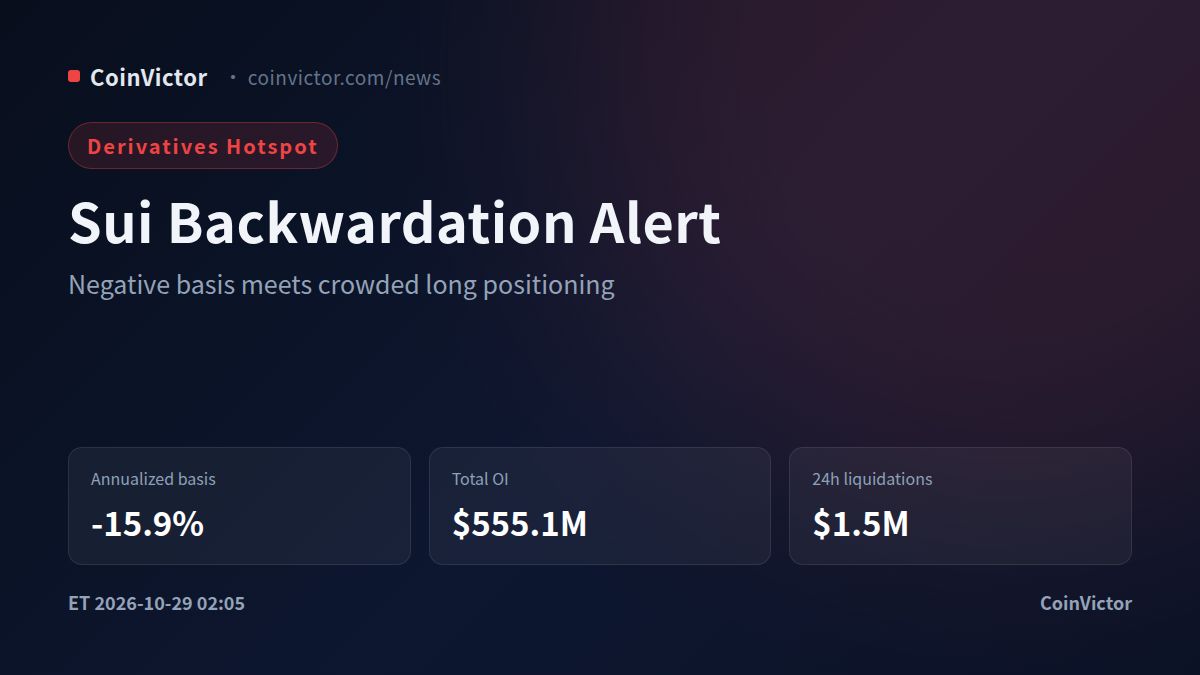
Sui is showing a clear backwardation signal: its futures basis is -0.043635%, equivalent to -15.9% annualized, while total open interest sits at $555.1M after falling 2.1% over 24 hours. The price is $0.9162, down 2.0%, and the derivatives picture is more defensive than the account-level positioning suggests.
Recent market commentary is split between a rebound thesis facing resistance and a more ambitious long-term forecast, but the derivatives tape is currently emphasizing downside hedging, uneven leverage and a crowded long bias.
OI is contracting unevenly
The largest open-interest concentration is at Gate, with $109.9M and a 19.8% share, followed by Binance at $102.4M and 18.4%. Bybit contributes $77.0M, or 13.9%, while Bitget holds $52.9M and 9.5%. These leading venues are not moving in the same direction. Gate OI has dropped 3.9% over 24 hours and 3.1% over the shorter window, while Bybit has declined 3.2% over 24 hours. Bitget is down 0.3% over 24 hours but up 2.5% over the shorter window.
Binance is the notable countertrend venue: its OI has increased 0.9% over 24 hours and 1.2% over the shorter window. OKX, with $30.3M and a 5.5% share, is nearly flat over 24 hours and up 0.6% over the shorter window. This mix suggests that the aggregate contraction is being led by deleveraging on sizable venues rather than by a uniform exit across the market. In a backwardated market, that matters: declining OI alongside a negative basis is more consistent with risk being removed than with fresh, confident short accumulation.
Funding confirms a divided market
The funding rate distribution is unusually fragmented. Binance is charging shorts through a negative -0.004832% rate, while Bybit is at -0.003756%, OKX at -0.002301% and Gate at -0.001600%. In contrast, Aster is at 0.010000%, Bitunix at 0.004993% and Lighter at 0.007200%. Bitget is mildly positive at 0.001300%, while Backpack is at 0.001250%.
The exchange split weakens any simple claim that the whole market is aggressively short. Negative funding on several large venues says longs are receiving payment there, a typical feature of backwardation, but positive funding elsewhere shows that leverage remains willing to pay for long exposure. The ticker-wide average is only 0.000706% as an eight-hour rate, so the broader carry signal is modest even though venue-level differences are material.
Liquidations expose the long-side weakness
Liquidation data gives the clearest directional warning. Over 24 hours, long liquidations reached $960.7K against $508.4K for shorts, from a total of $1.5M. The imbalance is even sharper over the shorter window: longs account for $295.9K over four hours, versus only $12.4K for shorts. Over twelve hours, long liquidations are $800.0K compared with $447.5K for shorts.
That structure fits the backwardation reading: crowded longs are being forced out while short liquidations are not yet large enough to produce a sustained squeeze. The largest recorded short events were at $0.9833 and $0.9828, worth $135.8K and $89.5K, while a notable long liquidation appeared at $0.8900 and was worth $82.1K. The market therefore has a visible liquidation corridor above the current price and a downside stress point near the recent long-liquidation level.
Positioning adds a useful contradiction. The overall account split is 75.1% long, but the ticker-wide taker split is only 42.3% long, meaning active market orders lean short. On Binance, accounts are 66.7% long while takers are 34.4% long; on Gate, accounts are 72.8% long and takers are 67.6% long. Passive accounts remain crowded long, while active flow is more willing to sell, especially on Binance.
Verdict: The dominant signal is bearish-to-defensive backwardation, not a clean short-squeeze setup. The key downside reference is $0.8900, while $0.9833 is the important upside liquidation level; aggregate OI is currently $555.1M. This view is invalidated if SUI reclaims $0.9833 while OI turns higher from $555.1M and the negative basis disappears, because that combination would show fresh demand replacing forced deleveraging. Data as of 14:05 Beijing time on Oct 29, covering Binance, OKX, Bybit and other major venues.